

 Melayu



Steel Structure Warehouse Sandwich Panels Guide: How to Choose EPS vs PU vs PIR vs Rockwool
When planning a steel structure warehouse or prefabricated industrial building, one of the most critical—and often underestimated—decisions is selecting the right sandwich panel core material. The insulated metal panel you choose affects not only the upfront budget, but also fire safety compliance, thermal efficiency, condensation control, acoustic performance, and long-term operating costs.
There is no universally "best" sandwich panel. The right choice depends on your project's priority: budget, insulation, fire rating, or a balance of all three. In this guide, we break down the four most common core materials—EPS, PU, PIR, and Rockwool (Mineral Wool)—to help you make an informed decision.
What Is a Sandwich Panel?
A sandwich panel consists of two outer metal skins (typically color-coated galvanized steel or aluminum) bonded to an insulating core. For steel warehouses, it serves as both the envelope/cladding and the thermal barrier in a single product. Common applications include:
Warehouse wall cladding
Roof panels for PEB (Pre-Engineered Building) structures
Cold storage and temperature-controlled logistics centers
Fire-rated partition walls in industrial plants
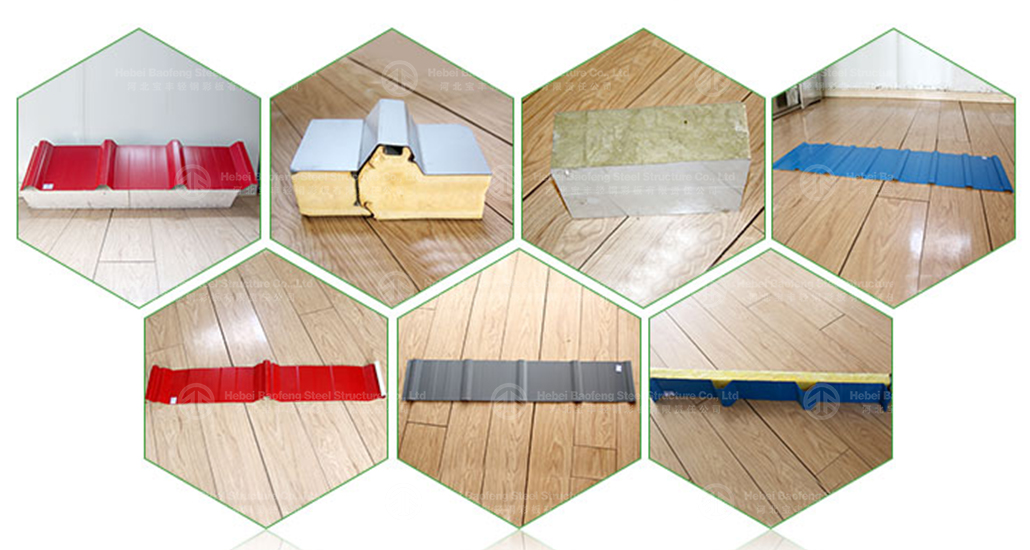
EPS (Expanded Polystyrene) Sandwich Panels
Pros:
Lowest initial cost among all core types
Lightweight (6–20 kg/m³), easy to transport and install
Adequate thermal insulation for non-temperature-controlled storage
Cons:
Limited fire resistance—typically B2/B1, melts under direct flame
Can absorb moisture over time if panel seals are compromised
Not suitable for cold storage or fire-code-strict projects
Recommended for: General storage warehouses in mild climates, agricultural buildings, temporary site offices, and budget-driven industrial sheds where fire rating is not a regulatory requirement.
PU (Polyurethane) Sandwich Panels
Pros:
Among the lowest thermal conductivity of common building insulations—thinner panels achieve high R-values
Closed-cell structure resists moisture penetration
Good structural rigidity and air-tightness
Cons:
Standard PU is combustible (B2/B1); verify flame-retardant formulation
Higher upfront cost than EPS
Requires proper sealing during installation to maintain performance
Recommended for: Cold storage facilities, food processing plants, refrigerated logistics centers, and warehouses in extreme hot or cold climates where energy efficiency is a priority.
PIR (Polyisocyanurate) Sandwich Panels
Pros:
Same excellent thermal performance as PU
Enhanced fire behavior—forms a charred, non-dripping layer when exposed to fire (B-s1,d0 / B1 class)
Increasingly accepted in projects requiring both energy efficiency and improved fire safety
Cons:
Slightly higher cost than standard PU panels
Still not fully non-combustible like rockwool
Recommended for: Pharmaceutical warehouses, high-end cold chain logistics, export-oriented industrial parks, and buildings subject to strict local fire codes that still require high thermal performance.
Rockwool (Mineral Wool) Sandwich Panels
Pros:
A1 non-combustible—withstands temperatures >1000 °C
Excellent sound absorption and acoustic dampening
Meets the strictest fire safety regulations (FM, EN, ASTM standards)
Cons:
Heaviest core option (100–150 kg/m³)—may increase steel frame loading
Slightly lower thermal insulation per mm vs. PU/PIR (requires greater thickness for same U-value)
Can absorb moisture if not properly flashed/sealed in very humid environments
Recommended for: Chemical plants, paint booths, textile factories, fire-rated partition walls, and any facility where fire safety or noise control is non-negotiable.
How to Choose the Right Panel Thickness
Panel thickness is driven by climate, indoor temperature requirement, and local energy/fire codes:
50 mm – Mild climates, general storage, budget-focused projects
75–100 mm – Most common for balanced thermal performance in standard industrial warehouses
100–150 mm – Cold regions, cold storage, or buildings with strict condensation/energy targets
Kategori
blog terbaru


Untuk Pertanyaan mengenai produk atau pricelist kami, sila tinggalkan kepada kami dan kami akan berhubung dalam 24 jam.
© hak cipta: 2026 Hebei Baofeng Steel Structure CO.,LTD Hak cipta terpelihara.

IPv6 rangkaian disokong


 +8615720226351